We initially wrote about silver in July 2020, providing an update in 2022. With the latest rally in precious metals, it seemed fitting to bring everyone back up to speed.
Both silver and gold have outperformed equities over the past 5 years, with gold returning 87.6%, silver 113.5% and the MSCI World climbing 58.63%.
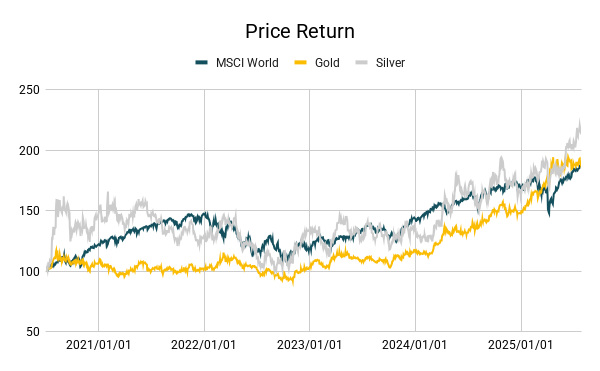
Although precious metals have outperformed equities over the past 5 years, a large portion of their outperformance has been since Trump was inaugurated for his second term.
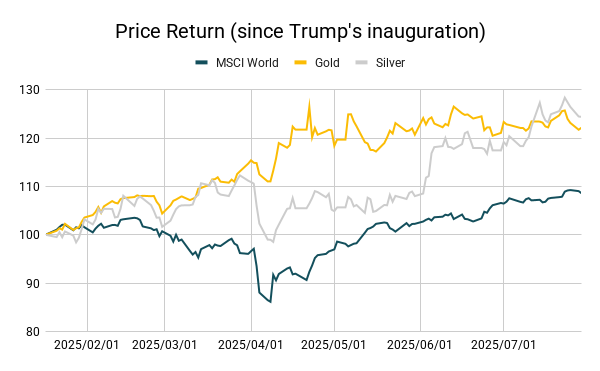
Precious metals are inherently driven higher by Supply and demand, the relative strength of the USD, economic growth, geopolitics, inflation and interest rates. Two factors which have been prevalent so far in 2025 are geopolitical risk and uncertainty. Silver demand has been additionally driven by its industrial capabilities and the surge in green energy alternatives, while supply (which is largely a by-product of base metal mining) has continued to be at a deficit. The gold/silver ratio continues to be supportive of silver’s expected outperformance relative to gold.
“Industrial demand remains strong, with structural deficits continuing into 2025 – potentially driving prices to USD 40 – USD 50 per ounce by year end” – Reuters
The economics
Many of these drivers are inter-connected. For example, weak economic growth will detract from industrial demand for silver and lead to higher supply/a smaller supply deficit. In isolation, the below relationships should hold.
Supply
The main sources of silver supply are mine production and recycling. Mine production accounted for 819.7 million ounces of 2024 supply (80.8%), while recycling accounted for 193.9 million ounces.
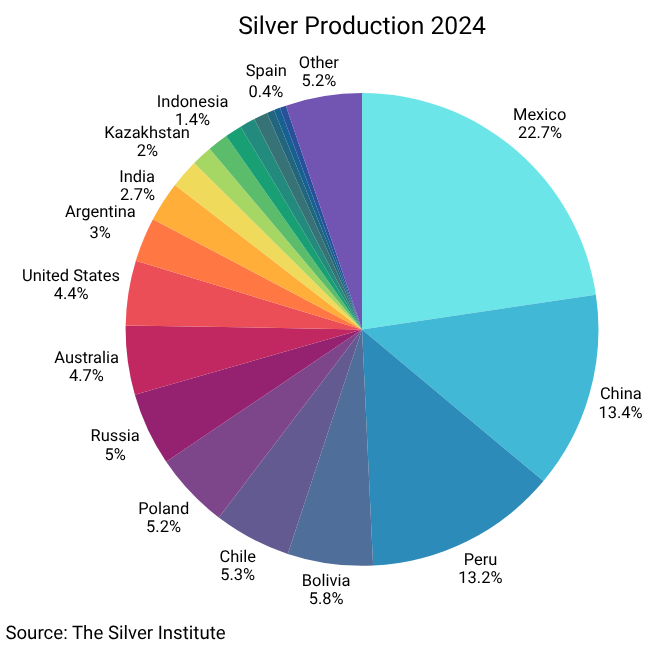
Silver mine production increased 0.9% in 2024. Largely a by-product of base metal mining, this increase predominantly came from higher output from lead/zinc mines in Australia and a recovery in Mexico. Although gold mines showed the strongest growth of silver output, up 12% for 2024, the main source of silver output remained lead/zinc mines. Mexico continues to be the largest producer of silver, with 185.7 million ounces in 2024.
Additional silver supply came from recycling, which was up 6% for the year. Industrial scrap accounted for the largest portion of recycled silver (in terms of weight) due to increased processing of Ethylene Oxide (EO) catalysts. Silverware recycling was additionally higher due to inflationary pressures.
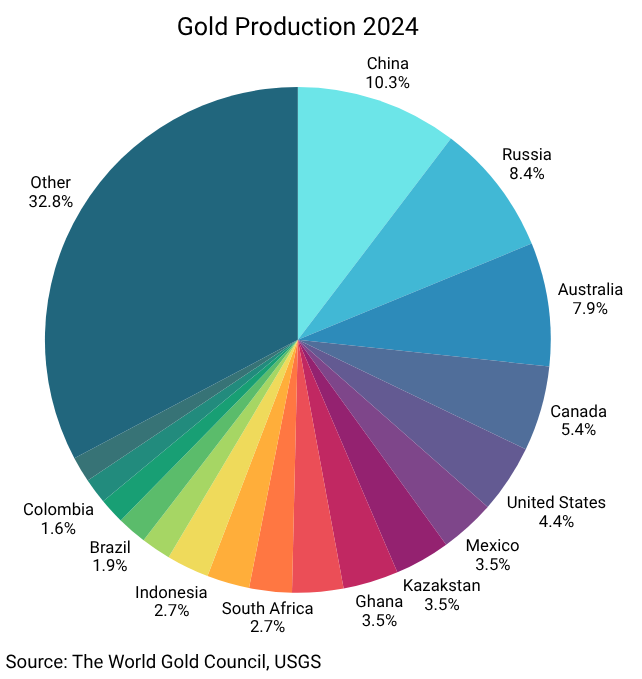
The main source of gold supply is similarly from mine production, but (unlike silver) it is not reliant on the mining production of alternate metals. Mine production accounted for approximately 72.8% of 2024 supply, while the balance came from recycling. South African gold production amounted to approximately 100 metric tonnes (USGS), falling between Uzbekistan and Peru.
Demand
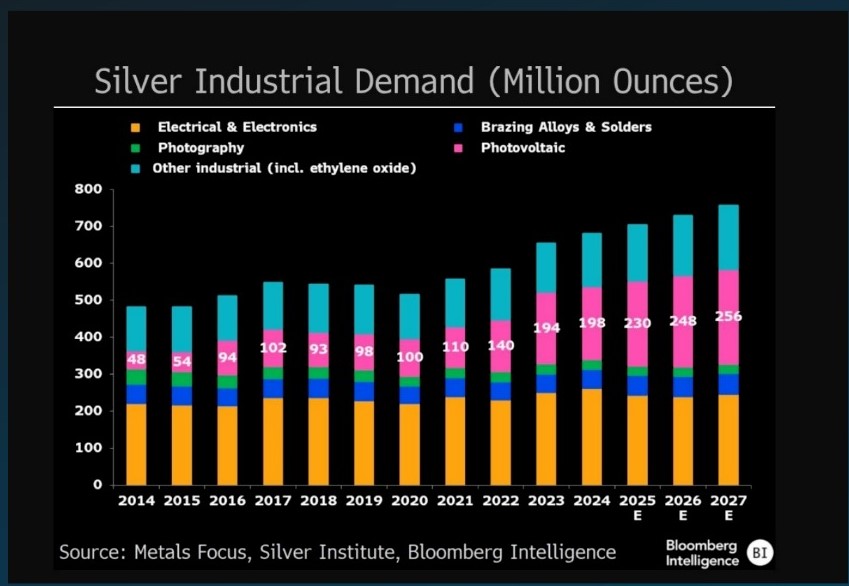
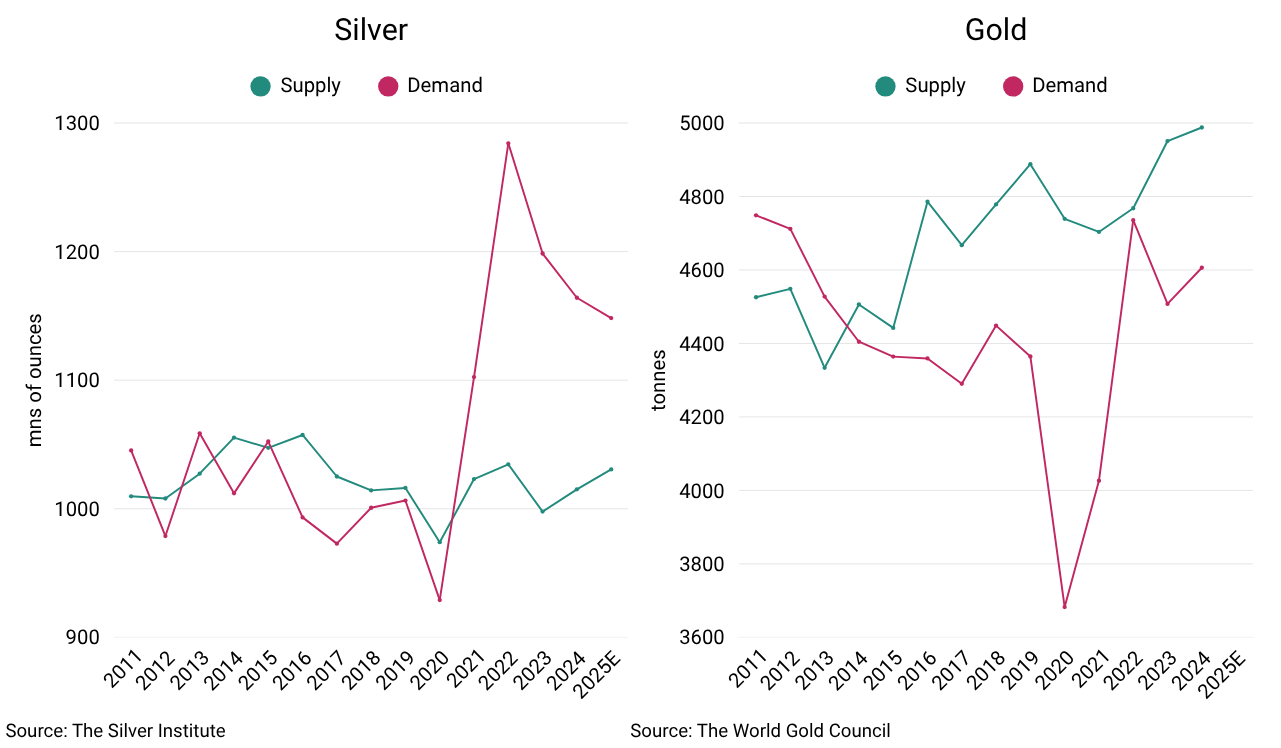
Silver industrial demand remained strong in 2024, while physical investment, silverware and photographic demand were slightly weaker. Overall, demand was 3% lower at 1.16 billion ounces (still above the 2024 supply). Industrial demand primarily comes from electronics and electrical demand, driven by the photovoltaic (PV) and automotive sectors, as well as grid infrastructure development. Advancements in PV have led to a decline in demand, whilst AI related applications positively impacted demand.

Gold demand increased 2% in 2024, driven by investment demand which increased 25% from 2023. Investment demand has continued into 2025, up 170% in Q1 (versus Q4 2024). Geopolitical uncertainty, coupled with inflation concerns, rate cut expectations and a weaker dollar have continued to be supportive of investment demand so far this year. Average gold trading volumes were at USD 329 bn per day for the first half of 2025 (the highest semi-annual figure to date). Central banks have additionally contributed to demand, as they continue to purchase reserves in an attempt to diversify their exposure to the USD. Of note is the People’s Bank of China, having increased their reserves from approximately 3% of total foreign exchange reserves at the end of 2022 to approximately 7% as at the end of June 2025. Continued geopolitical conflicts should be supportive of foreign exchange reserve diversification going forward.

USD
Although the USD has seen some recent strength, the currency has been relatively weak over the past year. The below chart shows the USD relative to a basket of currencies (EUR, JPY, GBP, CAD, SEK, CHF), namely the US Dollar Index (DXY). The index was developed by the US Federal Reserve in 1973 to indicate the relative strength of the USD. It is based on the trade-weighted average value of the USD against global currencies. As the USD appreciates, the index increases and vice versa.
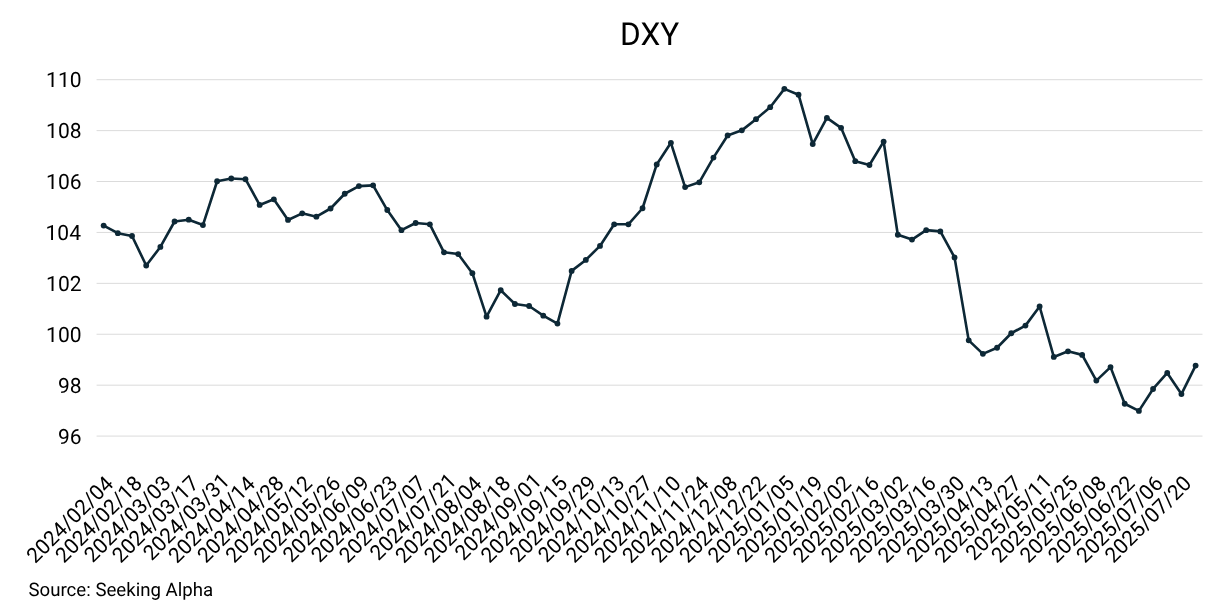
Trump has been vocal about his stance on the benefits of a weaker USD. His argument is that the strength of the USD results in US exports being less competitive, inflates the trade deficit and has had an adverse impact on the US manufacturing sector and jobs as a result. Trade tariff uncertainty, coupled with general uncertainty around policies and practices in the US have led to large outflows and disinvestment from the region, contributing to a weaker dollar.
The weaker USD has been supportive of precious metal prices year to date.
Economic Growth
Precious metals have a very low correlation with traditional asset classes, making them an attractive holding during market pullbacks. The mechanics are slightly more complex when it comes to silver. Should industrial activity slow, industrial demand for silver will follow suit – potentially outweighing the increased demand from investments.
As per their latest report (July 2025), the International Monetary Fund (IMF) projects global growth of 3.0% for 2025, 3.1% in 2026. Although an upward revision from the April 2025 World Economic Outlook, the rate is still slowing from the 3.3% achieved in 2024. The improvement reflects ‘front-loading ahead of tariffs, lower effective tariff rates, better financial conditions, and fiscal expansion in some major jurisdictions. Softening the blow for silver, industrial economies, China and India, are expected to see 4.2% and 6.4% GDP growth respectively.
The latest US GDP number (Q2) came in above expectations, at 3%, and drove risk-on sentiment amongst investors. The data was however followed by the Fed downgrading their outlook for the US economy.
Geopolitics
The main sentiment amongst market participants is uncertainty. From the details surrounding tariffs to the independence of the Fed, participants are concerned about the future. Although we have seen a slight uptick in sentiment, evident in “risk-on” share buying and emerging market traction post positive trade developments, the general tone is cautious overall. Precious metals tend to do better in a risk-off environment.
Inflation
Inflation has been consistently above the Fed’s 2% target (one of the reason’s Powell is reluctant to cut interest rates). Once imposed, the tariffs will add an average of around 15% on to the total cost of goods purchased in the US. According to the IMF, global inflation is expected to decline, but US inflation is expected to remain above target. Precious metals tend to do better in a high inflation environment.
Interest Rates
Growing fiscal deficits, particularly in the US, are also supportive of gold prices and demand amongst central banks who wish to grow their hard assets. Higher bond yields mean higher interest costs for governments on the debt they are borrowing, having an adverse impact on their ability to spend. The US Federal budget deficit has deteriorated over the past 10 years, now sitting at approximately 6% of GDP. The deficit is estimated to rise to 7.3% of GDP by 2055 according to the Congressional Budget Office, while public debt to GDP is expected to rise from 100% to 156% by 2055.
Trump has been placing pressure on Powell to cut interest rates, threatening to “fire” him. Although Trump does not have the authority to do this, it has led to raised concerns amongst market participants that the Fed will lose its independence and credibility in the future.
Expectations for lower interest rates in the near term have been supportive of precious metal investments and their allure amongst safe haven assets as bonds become less competitive. The Fed’s decision on the 30th of July to maintain rates, coupled with Jerome Powell’s doveish comments and the better than expected GDP number which came out, resulted in a reversal of some of the optimism around rate cuts. Powell’s tone was supportive of keeping rates higher for longer.
How long can the bull charge before running out of steam?
Another area noted as a potential risk to precious metal prices, one which is perhaps more prevalent for silver, is the price in relation to its all-in sustaining cost (AISC) of production. Silver is currently trading at well above its AISC, incentivising increased supply which would have a negative impact on prices in the future (if demand does not increase at a similar or greater rate).
There is concern around the impact of lower silver demand for solar capacity. 597 GW of global solar capacity were added in 2024, up 33% for the year. The projected growth for 2025 is at 10%. Should growth slow further or dimmish completely, demand for alternative industrial uses will need to counter the impact on overall demand. As technology develops, demand for silver is becoming more apparent.
A continuation of the current geopolitical uncertainty will be supportive of precious metal prices. As the dollar weakens and trade tensions intensify (with their potential to fuel global inflation), elevated prices of precious metals should remain. Overall, the current economic environment is supportive of higher precious metal prices.
In addition to the Russia-Ukraine war, new conflicts have surfaced in the Middle East and trade disputes could spur on more conflict. Precious metals, as a trusted safe-haven when the USD has come under scrutiny, should see price appreciation off the back of increased investment demand.
Some recent trade deals have been better than expected, resulting in spouts of speculation around additional positive trade deals and risk-on sentiment. Although elevated treasury yields and a slightly stronger USD have put some pressure on precious metal prices towards the end of July, we do not foresee this as being long lived. Trump continues to threaten steep levies on important trade partners, and the market continues to await clarity on negotiations with various partners.
The main risks for precious metal prices are higher interest rates and/or a drastic improvement in sentiment – neither of which seem highly likely.
The consensus is for global GDP to remain under pressure, while global inflation etches higher, to above 5% in the second half of 2025 as tariffs come into effect. In this environment, central banks will most likely lower interest rates. Positive outcomes of trade negotiations are not necessarily expected to lead to improved sentiment or lower volatility, and geopolitical tensions do not appear to be cooling – all contributors to uncertainty.
According to the World Gold Council, “falling interest rates and continued uncertainty would maintain investor appetite, particularly via gold ETFs and over-the-counter transactions. At the same time, central bank demand is likely to remain robust in 2025, moderating from its previous records while staying well above the pre-2022 average of 500-600t”. The IMF notes that downside risks from potentially higher tariffs, elevated uncertainty, and geopolitical tensions persist.
For the remainder of 2025, we see the Fed more likely to cut rates than increase them, a relatively weaker USD and continued gold purchases by central banks as well as industrial demand for silver. Although some trade deals have been agreed to, we do not believe these to be overall supportive of lower precious metal prices. Further tariff announcements are highly likely, which will be supportive of elevated precious metal/safe haven prices.
“Should economic and financial conditions deteriorate, exacerbating stagflationary pressures and geoeconomic tensions, safe haven demand could significantly increase pushing gold 10%-15% higher from here. On the flipside, widespread and sustained conflict resolution – something that appears unlikely in the current environment – would see gold give back 12%-17% of this year’s gains.” – Goldhub
At the time of writing, the macroeconomic and market environment remains supportive of investment in precious metals. We continuously monitor news flow and global developments for any signals of changing dynamics which prompt adjusting portfolio positioning. As it currently stands, we believe there is merit in holding positions in both gold and silver given the current environment.