

Following the recent conflict between the US and Israel against Iran, the oil price went from around $70 to $112 (+60%). In this month’s newsletter, Henk Myburgh, CFA, discusses oil, its uses, substitutes and outlook.
In January 2022, Benjamin van Wyk wrote Dirty energy, bright opportunity – Pyxis Investment Management. Four years later, as expected, the world is still very much dependent on “Dirty Energy”. Oil consumption is higher than ever, even after a significant drive for clean energy. Oil is part of the modern world’s structural fabric, and its reach extends beyond providing energy. The recent spike in oil prices and the potential impact on the cost of living and inflation highlights this. Oil is not the only fossil fuel, but it is the most common one.
Oil: A 150‑Million‑Year Old Commodity Still Powering the Modern World
Oil is so embedded in daily life that it is often treated as a simple input for fuel prices and inflation forecasts. In reality, it is one of the most complex, strategic, and politically charged commodities in the global economy. Understanding where oil comes from, how it is used, and how its market has evolved is essential to forming an informed investment view.
What Oil Is – And Why It Isn’t Coming Back
Crude oil is the product of an extraordinary geological process. Around 150 to 400 million years ago, microscopic marine organisms – algae and plankton – absorbed carbon dioxide and sunlight through photosynthesis. When these organisms died, their remains settled on ocean floors and were gradually buried by layers of sediment. Over millions of years, heat and pressure transformed this organic matter into hydrocarbons: oil and natural gas trapped beneath impermeable rock.
This process effectively ended when Earth’s geology and atmospheric conditions changed, and the vast plankton-rich shallow seas that enabled it disappeared. The timescale involved—measured in tens of millions of years – means oil is non‑renewable for all practical human purposes. Every barrel used today permanently depletes a resource formed long before the first mammals roamed the planet.
Oil Before the Age of Engines
Before the invention of the internal combustion engine, in the late 19th century, oil was already valuable – but for very different reasons.
Early civilizations used bitumen and crude seep oil for waterproofing boats, binding bricks, sealing roofs, and as mortar in construction. In the 1800s, refined petroleum (kerosene) became a crucial fuel for lighting, replacing whale oil and making cities brighter, safer, and economically more productive after dark.
Oil was also used in medicines, lubricants, and cosmetics, while its by‑products found applications in dyes and basic chemicals. Energy use was a minor part of the picture until cars, trucks, ships, and aircraft rewired the global economy.
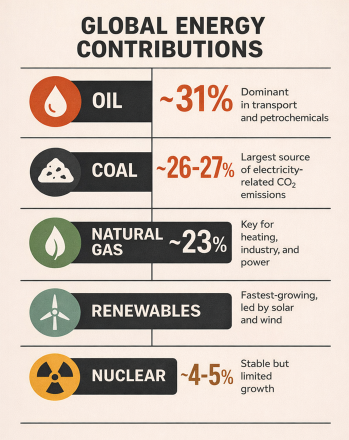
Today around 67% of oil produced is used as a source of energy, and this represents around 30% of the global energy contribution.
The world consumes roughly 100–102 million barrels of oil per day (or about 20 billion litres a day). That is enough oil to fill 8,000 Olympic pools or the equivalent drinking water needed by 27 million people over the course of a year.
Global Energy Mix (2024–2025 Data)
Oil Today: Far More Than Just Fuel
Today, oil is often purely thought of as an energy source – but that view is incomplete.
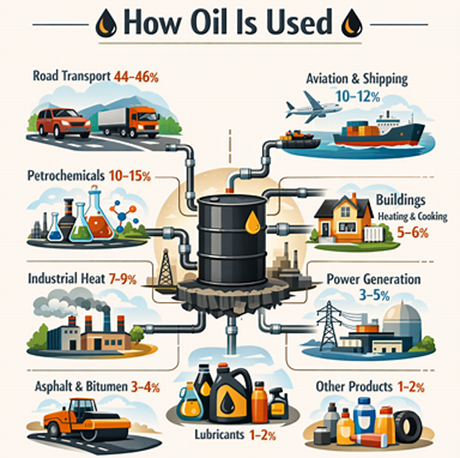
Note: In Petrochemical feedstocks oil is used as a raw material in:
- Plastics
- Synthetic fibres
- Fertilisers
- Solvents
- Pharmaceuticals
- Industrial chemicals
Petrochemicals account for ~70% of oil demand growth since 2019.
Even a world aggressively transitioning away from fossil fuels will continue to rely on oil for the many non‑combustion uses, for decades.
Looking ahead, advanced nuclear technologies, including small modular reactors (SMRs) and fusion, promise abundant clean energy but remain years away from large‑scale commercial impact.
None of the alternatives fully replicate oil’s unique advantages: portability, energy density, and versatility across transport, industry, and materials.
Fracking, Climate Change, and the Shifting Supply Map
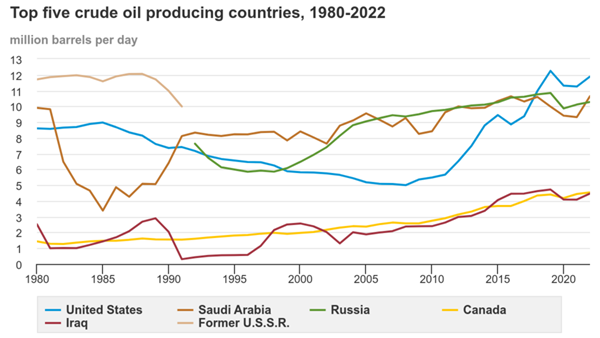
The most important supply‑side innovation in recent decades has been hydraulic fracturing (fracking). This technology unlocked vast shale oil resources in the United States, turning it from the world’s largest importer into the largest producer, overtaking Saudi Arabia and Russia.
At the same time, climate change concerns have reshaped investment.
Global supply has shifted from being dominated by OPEC toward a more fragmented mix, including the US, Brazil, Guyana, and Canada, even as geopolitical risk has risen.
Oil is inseparable from geopolitics. For decades, crude has been priced in US dollars, reinforcing the petrodollar system and supporting global dollar demand (dollar reserve currency status). Most of the historical price spikes came from supply shocks or concerns.
Oil revenues finance governments, fund wars, and shape alliances.
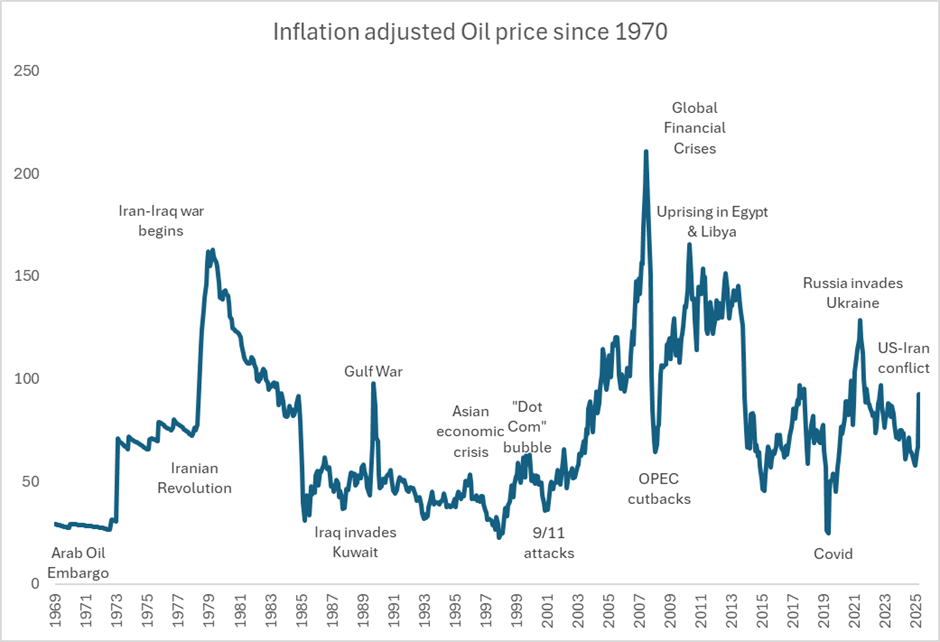
Conflicts in the Middle East, sanctions on Russia, tensions in shipping lanes (as is currently the case), and strategic petroleum reserves all influence prices.
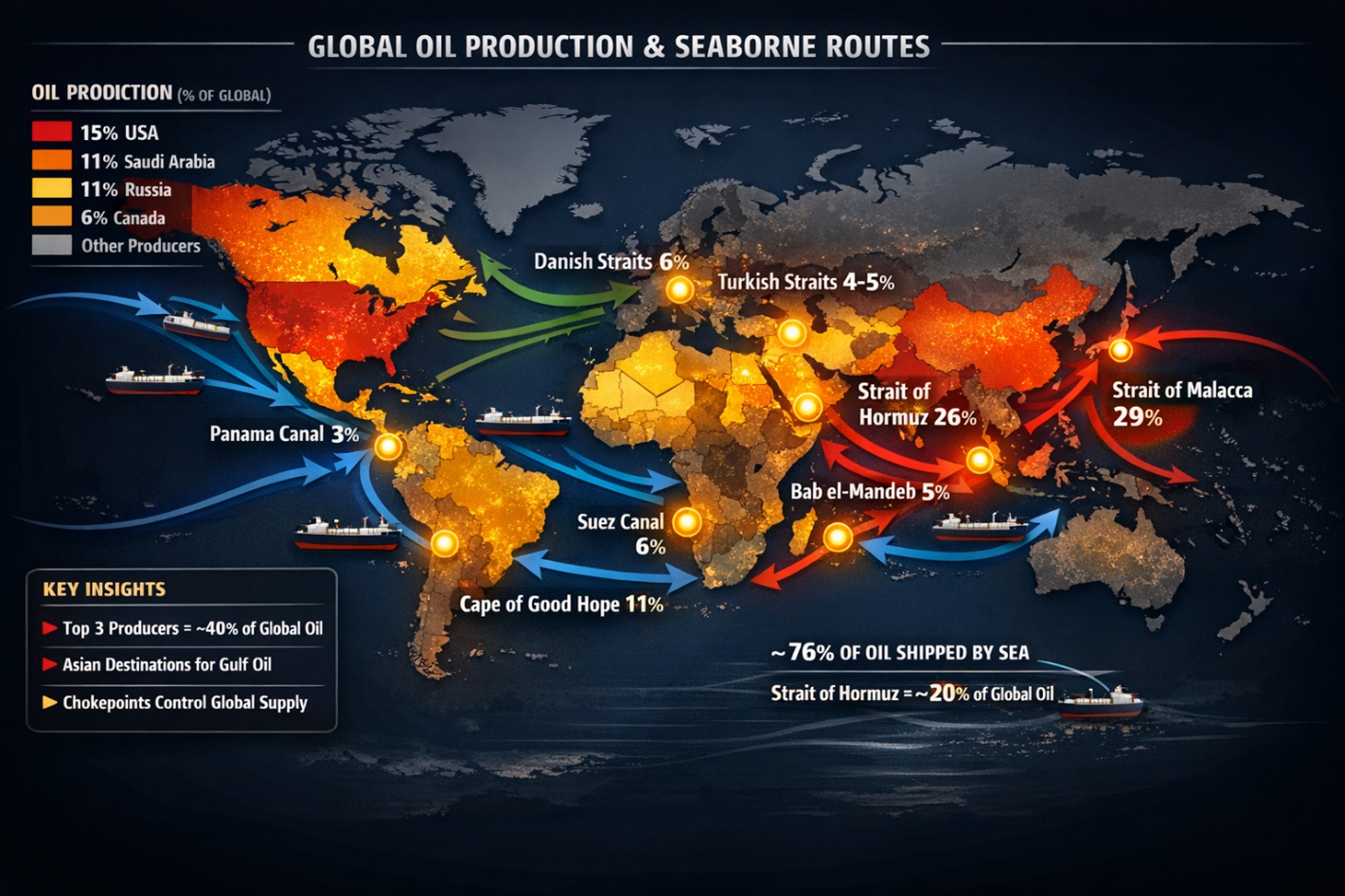
Demand: Slower Growth, Different Geography
While global oil demand continues to grow, its composition has changed, OECD countries have largely plateaued or declined due to efficiency gains, electrification, and aging populations. Emerging markets, particularly China, India, Southeast Asia, and parts of Africa, account for nearly all net growth. While Aviation, petrochemicals, and heavy transport remain difficult to electrify.
Oil demand is often inelastic, meaning consumers do not reduce usage significantly when prices rise – at least in the short term. Commuters still drive, goods still ship, and planes still fly as consumers do not have any real alternatives.
Inelastic Supply and the Cost of Under‑Investment
Oil supply is even more inelastic on the upside. New production requires years of exploration, permitting, drilling, and infrastructure investment. After a decade of capital discipline, ESG pressure, and volatile prices, global upstream investment remains well below pre‑2014 levels.
Break‑even (production cost) prices vary widely:
- Middle East conventional oil: $20–30 per barrel
- US shale: $40–60
- Deepwater and oil sands: $60–80+
This uneven cost curve increases the risk of supply shocks when demand surprises to the upside.
Winners and Losers When Oil Prices Move
When prices rise:
- Winners: Producers, oil‑exporting nations, service companies, some governments and energy substitutes (natural gas and coal).
- Losers: Airlines, transport firms, chemical companies, consumers, import‑dependent economies, and central banks fighting inflation.
Few commodities have such widespread economic reach.
Outlook: Higher for Longer, but With More Volatility
The investment case for oil today is paradoxical. Long‑term demand growth is slowing, yet short‑ and medium‑term supply constraints are tightening. Under‑investment, geopolitical risk, and the slow pace of substitution suggest continued price volatility with a bias toward higher floors.
In short: oil may be a sunset industry – but the sunset is much further than commonly believed – requiring many technological advances and breakthroughs to facilitate an energy transition.
For these reasons, we have held a long-term view on energy prices increasing. Pyxis’ client portfolios are typically more exposed to energy (oil, natural gas and coal) than in relevant benchmarks. We continue to monitor the investment case of energy as new information presents itself and will adjust appropriately where needed.