
“Artificial Intelligence is the new electricity.”
– Andrew Ng, Co-founder of Google Brain, Coursera, and Stanford Professor.
Introduction to Artificial Intelligence
Artificial Intelligence (AI) is transforming industries across the globe, ushering in an era where machines can perform tasks that previously required human intelligence. From self-driving cars to AI-powered healthcare systems, AI is at the forefront of cutting-edge innovations. At its core, AI aims to replicate human cognitive functions, such as learning, reasoning, problem-solving, and decision-making.
The journey of AI began in the 1950s, with the theoretical work of pioneers like Alan Turing, who introduced the concept of a machine that could simulate any human intelligence, later known as the Turing Test. In the decades that followed, AI progressed through periods of optimism, followed by “AI winters” where the enthusiasm waned due to technical limitations. Today, AI is experiencing a renaissance, driven by advances in machine learning (ML), deep learning (DL), and access to vast amounts of data and computing power.
Industry Trends in AI
The AI industry is evolving rapidly, with several key trends shaping its future:
1. Machine Learning and Deep Learning: These fields enable machines to learn from data, improving their performance over time without being explicitly programmed. Deep learning, a subset of machine learning, uses multi-layered neural networks to model complex patterns, revolutionising fields such as image recognition, speech processing, and autonomous driving.
2. AI in Healthcare: AI is transforming healthcare by providing predictive analytics, personalized medicine, and automated diagnostics. AI algorithms can analyze vast amounts of patient data to identify trends, predict disease outcomes, and recommend treatment options, all of which have the potential to significantly reduce costs and improve patient outcomes.
3. Autonomous Vehicles: Companies like Tesla, Waymo (majority owned by Google parent, Alphabet) and Uber are at the forefront of AI-driven autonomous vehicle development. These vehicles use AI to navigate complex environments, improving safety and efficiency.
4. AI in Finance: AI is reshaping financial services with applications in fraud detection, credit scoring, and algorithmic trading. The rise of robo-advisors powered by AI offers low-cost, personalized investment advice to individuals, democratising access to financial planning.
5. AI in Automation: The rise of robotic process automation (RPA), coupled with AI, is driving efficiency across industries. From manufacturing to customer service, AI-powered automation is eliminating repetitive tasks, allowing human workers to focus on higher-value activities.
6. AI Ethics and Regulation: As AI becomes more integral to decision-making, ethical considerations are becoming increasingly important. Issues like bias in algorithms, data privacy, and accountability are gaining attention from regulators. Governments around the world are beginning to implement frameworks to address these concerns, ensuring that AI technologies are developed and used responsibly.
Historical and Expected Growth of the AI Industry
AI’s potential is reflected in its growth trajectory. The AI market has experienced rapid growth in recent years, and it is expected to continue expanding. According to Grand View Research, the global AI market was valued at USD 136.6 billion in 2023 and is projected to grow at a CAGR of 37.3% from 2024 to 2030.

AI Investment Opportunities and Risks
Investing in AI offers a range of opportunities, but it also comes with risks. Here’s a closer look at the benefits and challenges for investors:
Opportunities
1. High-Growth Sector: The AI industry is poised for high growth, driven by the demand for AI solutions across multiple sectors such as healthcare, automotive, finance, and manufacturing.
2. Transformational Impact: AI has the potential to disrupt entire industries. Companies utilising AI can improve efficiency, reduce costs, and develop new products and services that were once thought impossible.
3. AI-Focused ETFs: For investors seeking diversified exposure to AI, there are several AI-focused ETFs. These funds provide access to a basket of AI-related companies, spreading the risk and potential reward across multiple players in the sector.
4. AI Startups: AI startups offer substantial growth potential but come with higher risk. Venture capital and private equity investors are increasingly targeting AI-driven startups, particularly those focused on breakthrough technologies like generative AI and autonomous systems.
Risks
1. Technological Uncertainty: AI is a rapidly evolving field. Companies that fail to innovate and adapt to emerging technologies could quickly lose their competitive edge. Investors must be cautious about overvaluing companies based on future projections alone.
2. Regulatory Risks: As AI technologies become more prevalent, governments are increasing their focus on regulation. Potential data privacy concerns, anti-competitive behavior, and ethical issues related to AI could lead to tighter regulations, impacting the growth potential of AI companies.
3. Overvaluation: There is a risk that some AI companies are overvalued. While the market for AI is expanding, some stocks may be priced for perfection, leading to potential price corrections. Investors should focus on companies with strong fundamentals, rather than speculative growth stories.
Valuation of AI Companies’ Stock Prices
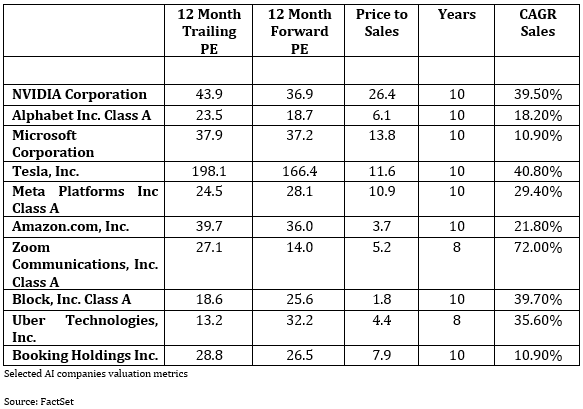
Valuing AI companies presents a unique challenge, as many of the leading players in the sector are in early growth phases and not yet profitable. Traditional metrics like Price-to-Earnings (P/E) ratios may not apply to these high-growth companies. Instead, investors often rely on Price-to-Sales (P/S) ratios or forward earnings multiples.
Are AI Company Shares in Bubble Territory?
As AI stock prices surge, many investors are asking if these valuations are sustainable or if a bubble is forming. The parallels to the Dot-com Bubble of the late 1990s are hard to ignore, especially with companies like NVIDIA and Tesla, and experiencing massive stock price growth.
Comparison to the Dot-com Bubble
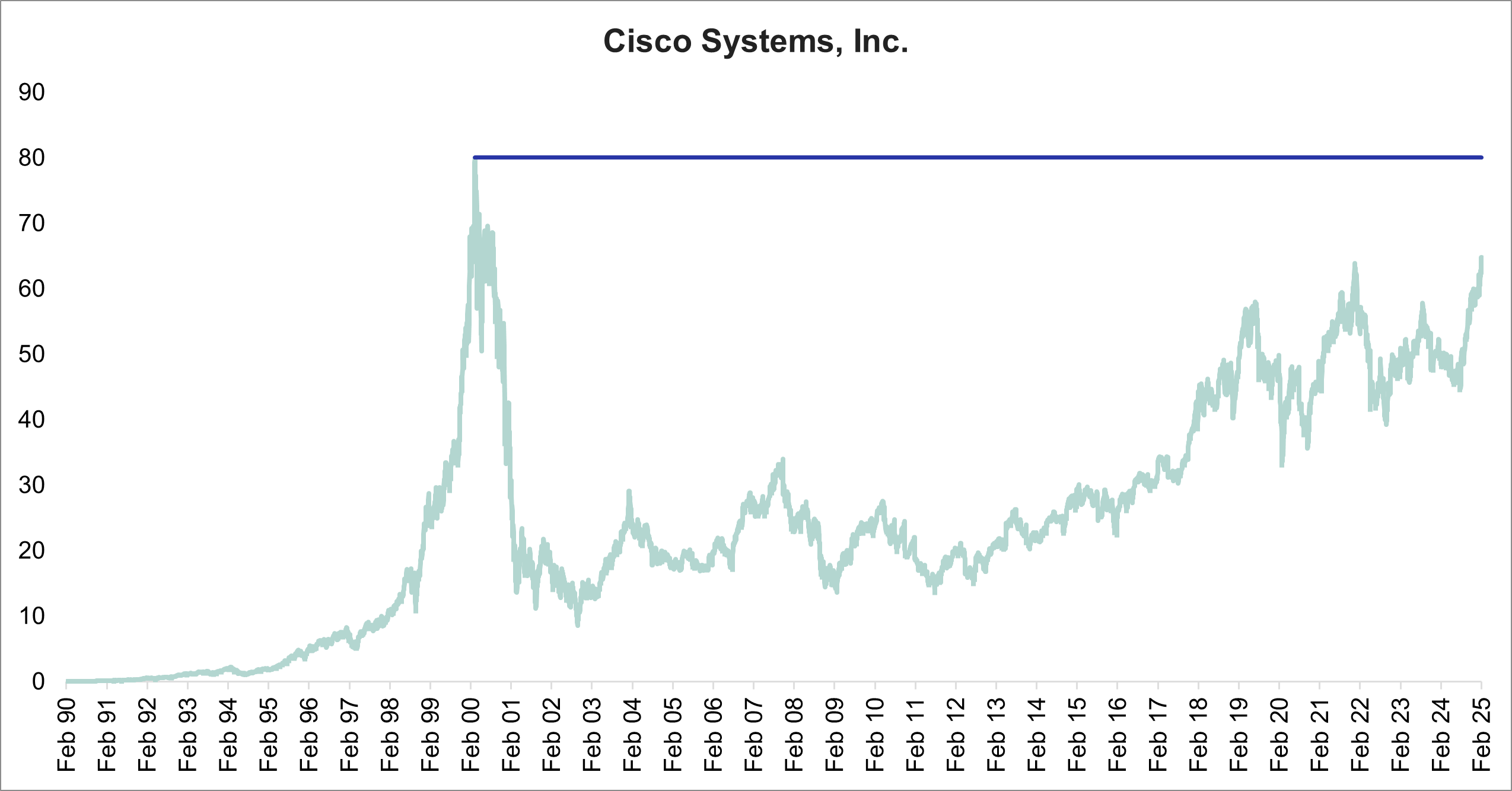
The Dot-com Bubble of 2000 saw tech stocks skyrocket, only to collapse once the market corrected. Companies like Cisco were once worth hundreds of billions, only to lose much of their value after the bubble burst.
Cisco, a key player in the Dot-com Bubble, reached a peak valuation of USD 555 billion, after its share price grew at a compound annual growth rate of approximately 76% in the preceding 10 years prior to the bubble bursting and wiping out much of its market value. At the peak of the Dot-com bubble, Cisco shares traded on price-earnings (PE) and price-to-sales (PS) multiples of 308 and 21! Investors paying up for the potential growth promised by the development of the internet, have still not recovered their losses. It is not to say that Cisco was a bad company, but investor hype surrounding the prospects of the internet, resulted in inflated valuations and investors overpaying for the growth potential of Cisco.
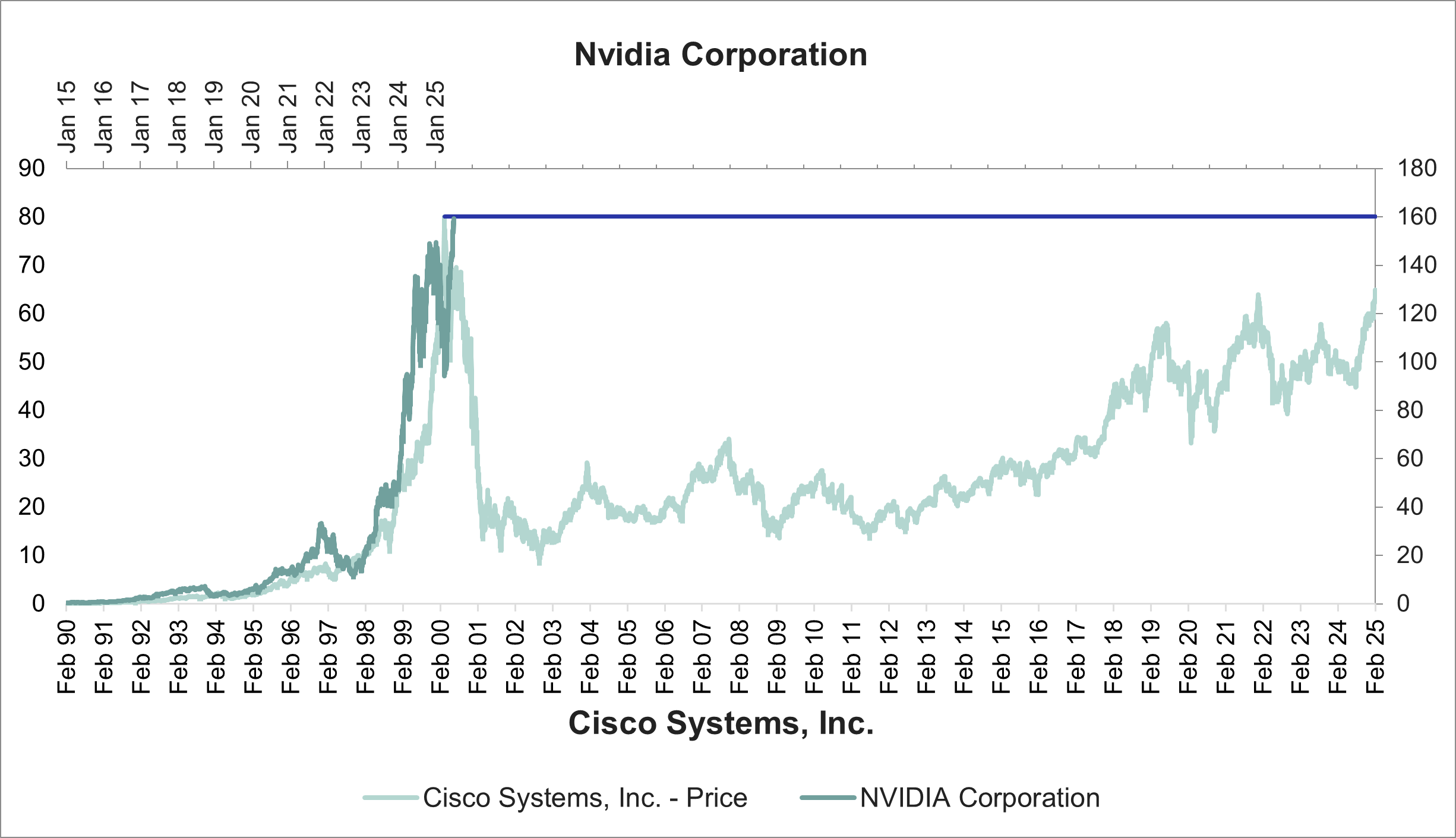
In contrast, NVIDIA has seen its stock price soar, especially after its dominance in AI hardware, making it one of the most valuable companies in the world today.
While NVIDIA and other AI companies like Tesla have tangible products and growing revenues, there is a growing concern that some of these stocks are being priced based on speculative expectations rather than current financial fundamentals.
The chart below, viewed in isolation, is not an in-depth analysis by any means, but there seems to be a similarity between the share price behavior of Cisco during the 1990’s and Nvidia today.
Major Listed Role Players in AI
Here are some of the key publicly listed companies driving the AI revolution:
1. NVIDIA: Known for its GPUs, NVIDIA’s hardware is central to AI model training, making it a key player in the AI space. Its CUDA platform has become the industry standard for AI research and development.
2. Alphabet (Google): Google has been a pioneer in AI, particularly through Google AI and DeepMind. It is leading advancements in natural language processing (NLP), computer vision, and machine learning tools for businesses.
3. Microsoft: With its Azure AI platform, Microsoft is providing businesses with AI solutions across the cloud. The company has also partnered with OpenAI, advancing GPT-based models like ChatGPT.
4. Tesla: Tesla is a leader in autonomous driving technology, powered by its AI-based Full Self-Driving (FSD) system. The company is at the cutting edge of AI in transportation and energy systems.
5. Meta (formerly Facebook): Meta is heavily invested in AI for advertising, content moderation, and the metaverse. The company is applying AI to create immersive virtual environments and enhance its social media platforms.
6. Amazon: Amazon’s dominance in AI-driven e-commerce, cloud computing (AWS), and logistics makes it one of the most influential players in the AI space.
7. Zoom: Zoom Video Communications leverages AI for virtual meetings, enhancing user experiences through features like real-time transcription, background noise suppression, and automatic meeting summaries. AI also powers Zoom’s virtual assistants and automated scheduling, improving productivity for users.
8. Block (formerly Square): Block is integrating AI to enhance its payment solutions and improve fraud detection and risk management. The company also uses AI to analyze transaction data and optimize merchant services through predictive analytics.
9. Uber: Uber uses AI to optimize ride-sharing algorithms, improving route planning, demand prediction, and pricing models. AI is also central to Uber’s development of autonomous vehicles and delivery services, driving efficiency across its platforms.
10. Booking Holdings: Booking.com, a part of Booking Holdings, uses AI to personalize user experiences and optimize search results for travel bookings. AI also powers recommendation engines, helping users find relevant travel options based on preferences and past behaviors.
Conclusion
The AI industry is poised for continued growth, offering substantial investment opportunities. However, as with any rapidly evolving sector, there are risks involved. Investors must carefully evaluate companies based on their fundamentals, growth potential, and ability to adapt to an ever-changing landscape.
While some may argue that AI stocks are in bubble territory, the difference between today’s market and the Dot-com Bubble of the early 2000s is that AI companies are often grounded in real-world applications with proven results. Investors should remain cautious, however, and ensure they’re making informed decisions based on solid data and realistic expectations.