
PYXIS
2026 September
Investment Management · Monthly Investment Letter
Monetary Policy · Rates & FX
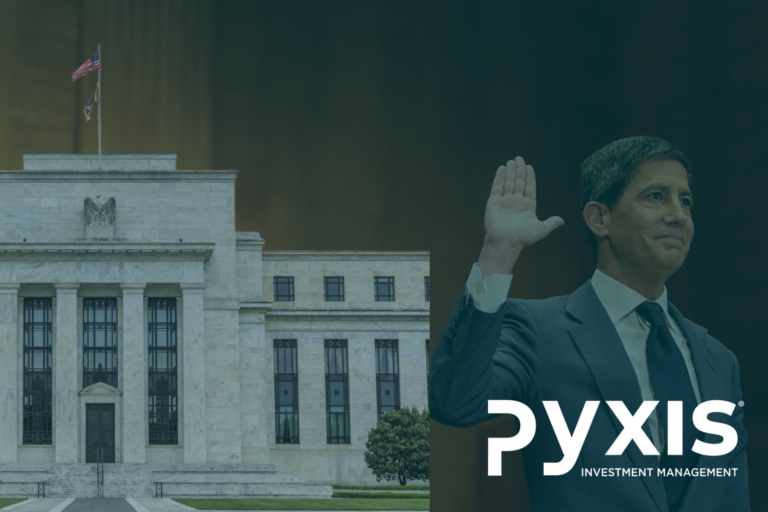
Warsh breaks his silence Markets now brace for a September hike
Fed Funds
3.50% – 3.75%
Held 9–3 at the July 29 FOMC meeting
SA Repo Rate
7.00%
Held 4–2 at the July 23 MPC meeting
Sept 16 FOMC
~60%
Odds of a hike, up from ~33% pre-speech
Sept 23 MPC
Hike Risk
Of a hike given elevated CPI and a firmer dollar backdrop post Jackson Hole
The Fed: A New Chair Finding His Voice
Kevin Warsh has deliberately pulled back from the detailed forward guidance markets grew used to under his predecessor. The early results have been mixed: his 29 July press conference left investors genuinely unsure whether the Fed remains fully committed to its inflation target. Inflation remains above target and the labour market is showing signs of cooling, a combination that leaves the Committee’s next move genuinely contested.
Warsh has described his approach as avoiding the “myopic” focus on quarter-point moves in favour of framing longer-run structural questions, suggesting that investors hoping for explicit near-term guidance may be disappointed.
Jackson Hole
Warsh Delivers a Hawkish Surprise
At his first Jackson Hole keynote on 28 August 2026, Warsh sent a clearer signal than expected.
“We must be confident that underlying inflation is moving to our objective, clearly and at sufficient speed. Otherwise, we have work to do.” Kevin Warsh, Federal Reserve Chair
He acknowledged that recent inflation readings were better than expected, but noted there was no indication that “underlying trends have meaningfully improved.” Warsh also described current financial conditions as “not restrictive,” which markets received as a genuine tightening bias rather than the neutral, structural remarks many had expected. He reaffirmed core PCE as the Fed’s preferred inflation gauge and its 2% target as “firm” and “fixed.” His preference for short-term rates as the Fed’s primary policy tool points to a shorter average duration on the Fed’s balance sheet, putting his stance somewhat at odds with the Treasury’s recent move to step up long-bond buybacks.
The market reacted quickly. Fed funds futures moved toward a 60% chance of a September hike, up from about 33% before the speech, and Deutsche Bank is now looking for 50bp of hikes across the September and December meetings. The dollar and Treasury yields rose, equities softened, and gold gave back part of its August rally.
With no clear resolution in the Middle East and inflation pressures still evident, a higher-for-longer rate environment is central to our positioning at Pyxis. The IEA’s latest report forecasts oil supply falling by 4.3 million barrels per day in 2026, while demand is expected to decline by only 1.6 million barrels per day. We maintain energy as a portfolio theme and continue to hold an overweight in real assets such as precious metals.
The Gold Revaluation Debate and the Fed’s Own Balance Sheet
A separate but related thread worth noting is the resurgence of discussions around revaluing the US government’s gold reserves. A Federal Reserve staff note first raised the mechanics of such a revaluation in 2025, and the idea has resurfaced periodically since, including proposals tied to funding a sovereign wealth fund or a strategic bitcoin reserve.
Gold on the books vs. gold at market
$42.22/oz
Statutory Bretton Woods-era price (~$11bn on 8,130 tonnes)
$1trn+
Market value of the same holding at current prices
Although no revaluation has been adopted, and Warsh did not address the topic directly at Jackson Hole, it remains a relevant point for portfolio positioning. Should Congress raise the official gold price, the Fed’s gold certificates would be marked up accordingly, crediting the Treasury General Account with new funds without issuing new debt. Analysts have flagged this as a “messy” outcome for the Fed, since it would inject liquidity into the financial system and could complicate the ongoing balance sheet unwind.
Years of rate hikes have left the Fed sitting on large unrealised losses on its securities portfolio, pushing its own capital position deeply negative on a mark-to-market basis. A gold revaluation would not touch that securities portfolio, but it would strengthen the asset side of the consolidated federal balance sheet, recognising a large, real gain on an asset that has simply never been marked to market. Proponents frame it as a low-cost way to create fiscal headroom, while critics note it is a one-time accounting manoeuvre that does nothing to close the underlying deficit. Central banks that have gone down this path elsewhere, South Africa’s own use of Gold and Foreign Exchange Contingency Reserve Account gains to reduce borrowing being one recent example, have treated it as a supplement to fiscal discipline rather than a substitute for it.
Any revaluation will carry real implications for gold, the dollar and Treasury issuance if it moves from theoretical to actual.
Closer to Home: The SARB’s Balancing Act
The South African Reserve Bank’s Monetary Policy Committee held its repo rate at 7% on 23 July 2026, but the decision was far from unanimous. A 4–2 split revealed that two members favoured an immediate hike. Governor Lesetja Kganyago flagged clear upside inflation risk after June CPI printed at 5%, above the SARB’s target band, driven by elevated oil prices and continued rand weakness.
Consensus forecasts had pointed to the SARB holding through year-end, but that view predates the June inflation surprise, and Kganyago’s comments set up a real possibility of a 25bp hike at the September MPC meeting if inflation remains elevated. The prime lending rate remains at 10.5%.
Notably, the SARB’s path is not being set in isolation. Rand stability and the Fed’s own trajectory are explicit inputs into the Committee’s thinking, which means Warsh’s Jackson Hole remarks and the September FOMC decision carry real read-through for South African rates, bonds and currency positioning in the weeks ahead.
What We’re Watching Into September
As the third quarter of 2026 comes to a close, we continue to monitor these developments and how they shape client portfolio positioning. With both the Fed and MPC meetings in September, and consensus data pointing towards hikes, we believe we are appropriately invested to withstand a higher rate environment, and will make adjustments as opportunities present themselves.
Pyxis Investment Management
This newsletter is prepared for clients of Pyxis Investment Management (Pty) Ltd. It does not constitute financial advice and is generated for information purposes only. Past performance is not indicative of future results.
View the August 2026 market summary
View