
The valuation of a company changes depending on where it is in its lifecycle. A startup with no profits can attract multi-billion-dollar valuations based purely on its potential, while a mature company with stable earnings is valued primarily on its cash-flow predictability.
This month, we explore how valuation frameworks differ across company stages; how risk, growth, and earnings drivers evolve over time; why investors often struggle with early-stage valuations; and how investors can sometimes be swept away by the “story” behind a startup.
Company Valuation Through the Lifecycle
Companies evolve through distinct stages, each with different drivers of value.
Valuation Framework by Stage
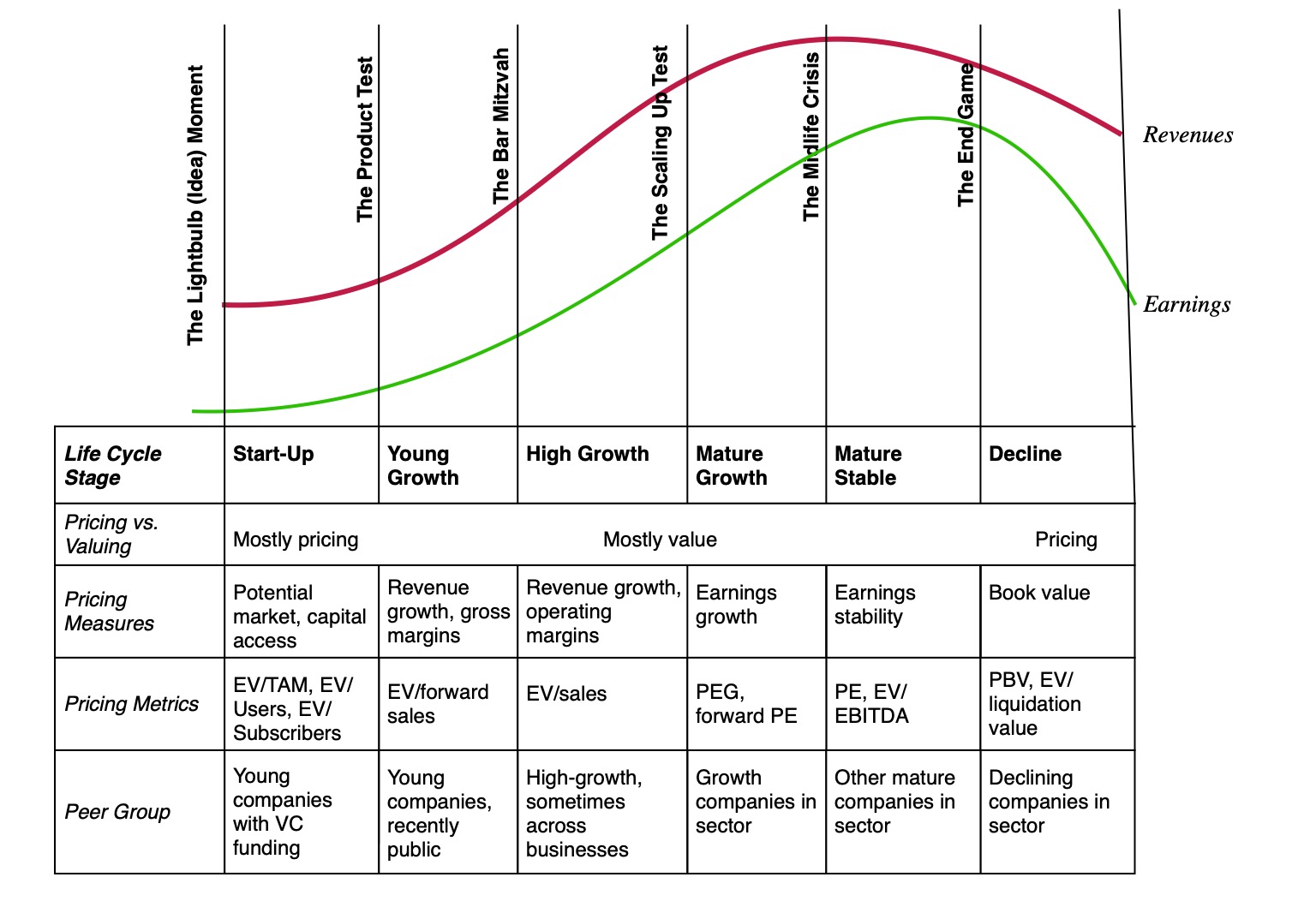
The chart below lists the typical pricing measure, metric and peer group by life cycle stage.
Initially most of a company’s value is derived from the “story” / potential. As a company matures, its value is derived from the earnings it produces.
(Source: Advisorpedia.com)
Valuation Tools
Valuation methods, such as: Discounted Cash Flow; comparable company multiples (Price/Earnings, Price/Sales); and Dividend Discount Models, work best when a company has predictable earnings, stable margins and a history which is long enough to forecast cash flows.
This is precisely why mature companies fit these methods cleanly.
Why investment managers are uncomfortable with startup valuations
Startups usually lack positive earnings, sometimes even revenue, reliable cost structures, visibility into margins, or clear evidence of long-term demand. Discounted cash flow models break down because early-stage cash flows are either:
- too uncertain;
- too far in the future; or
- impossible to project with any credibility.
As a result, many investment managers feel uneasy because early-stage valuations often rely on assumptions rather than fundamentals.
Startups are priced on the potential market size, team quality, adoption velocity and what the company could become, not what it is today.
This leads to a valuation style that feels more like probability-weighted imagination than traditional finance.
Why Investors Get Carried Away by “The Story”
Startups often come with compelling narratives such as charismatic founders, big visions (“reinventing X”), disruptive missions, emotionally appealing themes (AI, climate tech, biotech), and the possibility of enormous returns.
Humans are naturally drawn to stories, especially those involving dramatic change, asymmetric payoff, and early access to “the next big thing”.
It can lead to narrative-driven valuation, where investors place too much weight on what could happen and too little on what is likely to happen.
This is why early-stage investing requires discipline: the story may be exciting, but the underlying probability of success often remains low.
PayPal: A Case Study in Evolution
PayPal illustrates many of these themes. Its original idea – a cryptography-based payments system for handheld devices – was not what ultimately created value.
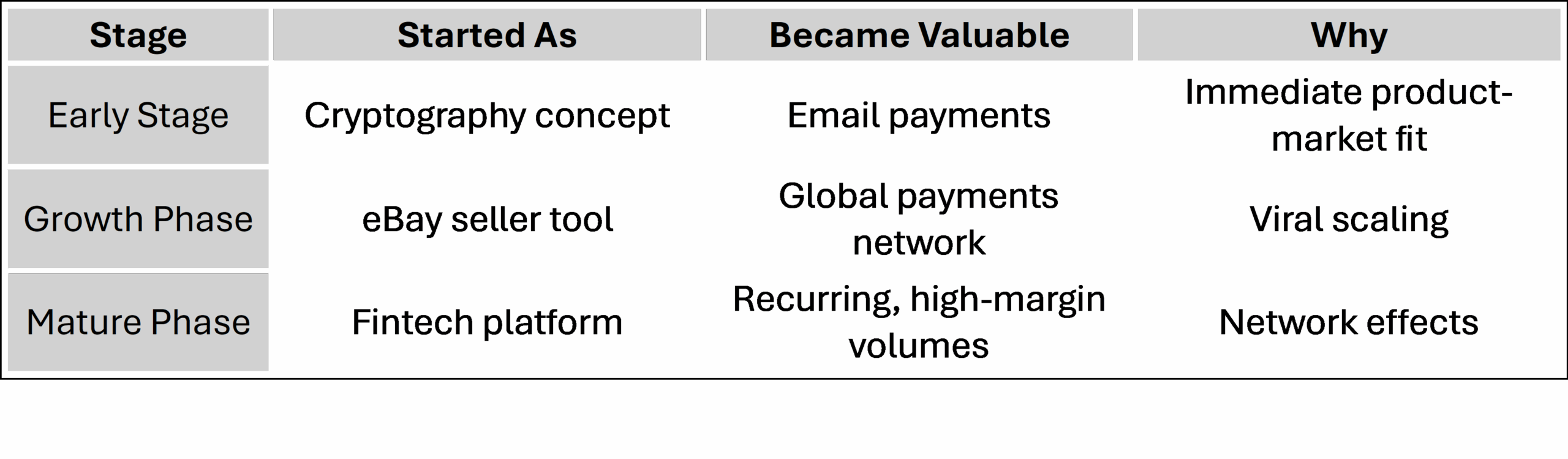
This evolution demonstrates why early-stage investing involves embracing uncertainty and pivot potential.
Why a diversified portfolio might include companies across stages
Portfolio allocation logic
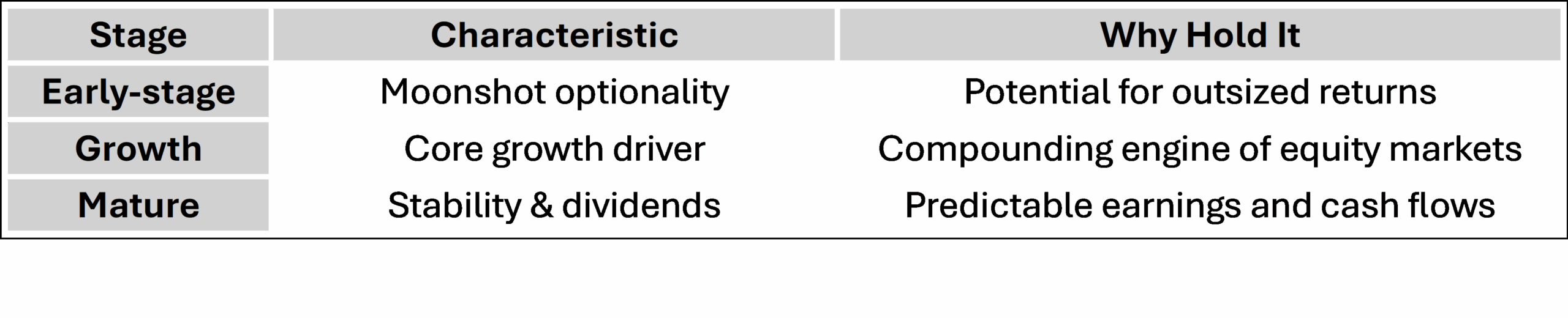
No single stage offers all three characteristics. Together, they potentially offer higher growth. It is worth noting that pure early-stage investing is usually only available through Venture Capital (VC) and Private Equity (PE) firms. But there are companies that operate across multiple stages simultaneously. Some companies behave like internal venture ecosystems, with mature cash-flow engines funding early-stage innovation.
Examples
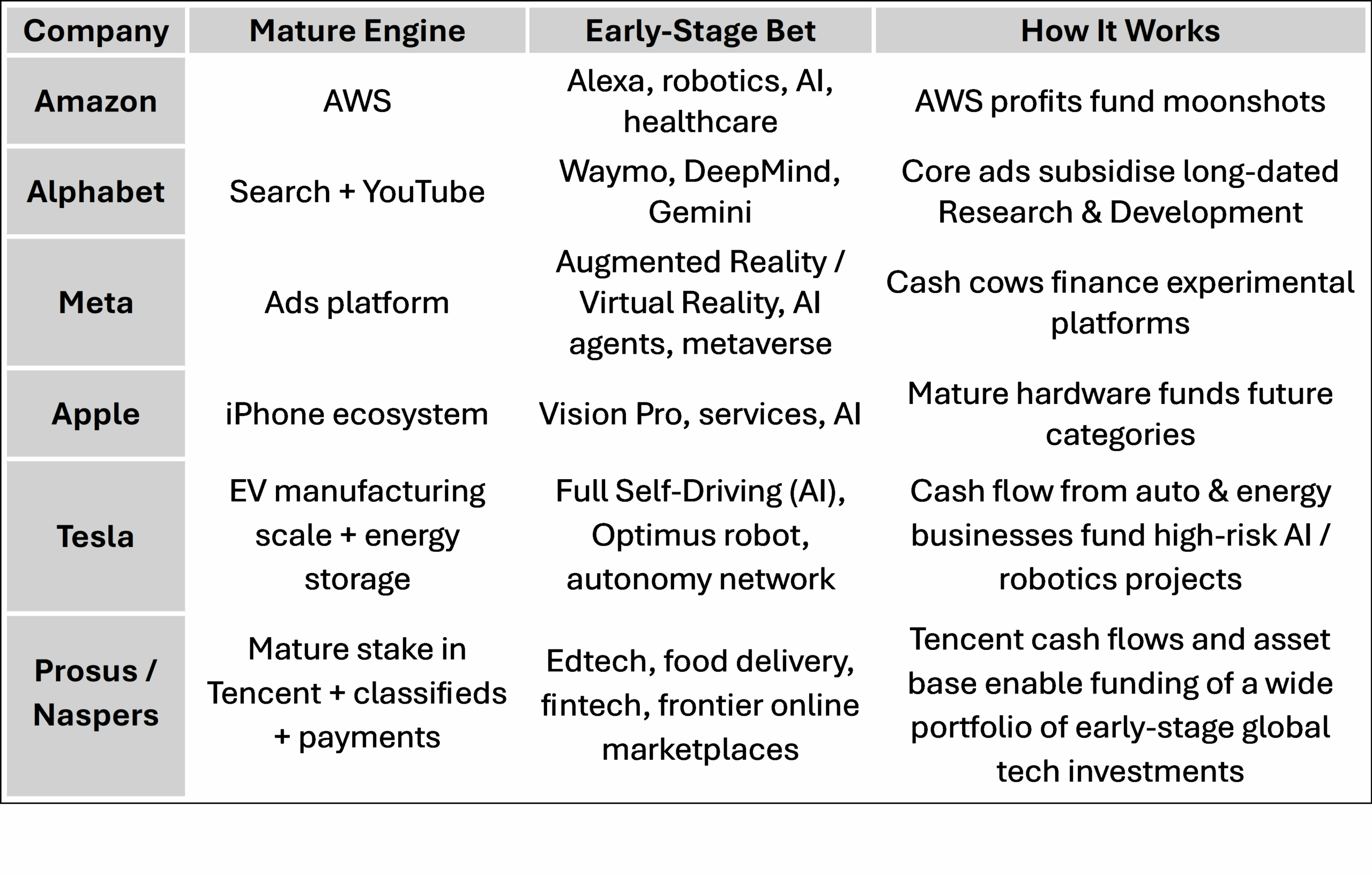
These firms give investors some startup-like exposure without startup-like bankruptcy risk and are listed companies making them accessible to the investment public.
Valuing companies requires an understanding of their lifecycle stage. Traditional valuation methods work well for mature firms but break down in early-stage contexts where visibility is limited. That tension explains why some investors feel uneasy about startup valuations and why others become enamoured with compelling narratives.
In essence there are three types of companies:
- pure startups powered by potential,
- pure mature companies driven by earnings, and
- hybrid giants funding innovation from stable profit engines.
A well-diversified portfolio should hold exposure not only to different industries and profit drivers, but also to companies with different growth prospects. From a risk point of view, it is important to balance cash flow reliability with innovation-driven growth within a portfolio.
We are investors at a time when breakthrough and disruptive technologies are being developed at a greater speed than ever before. The value that the market assigns to these potential breakthroughs are reflected in some of the biggest companies by market capitalisation.
If these “hybrid” company early-stage bets do not materialise, the associated component of their valuation will disappear, but there is very little risk of the company failing entirely. The biggest risk is that the market gets carried away with “the story” and that, only time can tell.
At Pyxis, we follow a pragmatic approach to investing, we do not confine ourselves to one management style or asset class but rather allow flexibility to ensure appropriate allocations at any given time.
Currently, we prefer investing in mature, and to some extent “hybrid”, companies that offer pre-packaged mixed growth profiles to gain exposure to business segments that are still in early stages of development to balance the uncertainty in cash generation with mature and more predictable cash generation.