
The Goldilocks Yield
Total Yield Insights: Dividends, Buybacks & Beyond
In this newsletter, we will look at why companies return capital to shareholders, the methods used to achieve this and the arguments for and against the return of capital. We will additionally look at the benefits and drawbacks of each method, as well as shareholder yield (a more comprehensive measure of yield). We will end with the implications for investors.
Why would companies return capital to shareholders?
Companies typically generate capital from operations. When they lack viable opportunities to reinvest in growth – for example expanding operations, research and development (R&D), or acquisitions – they often choose to return that surplus to shareholders.
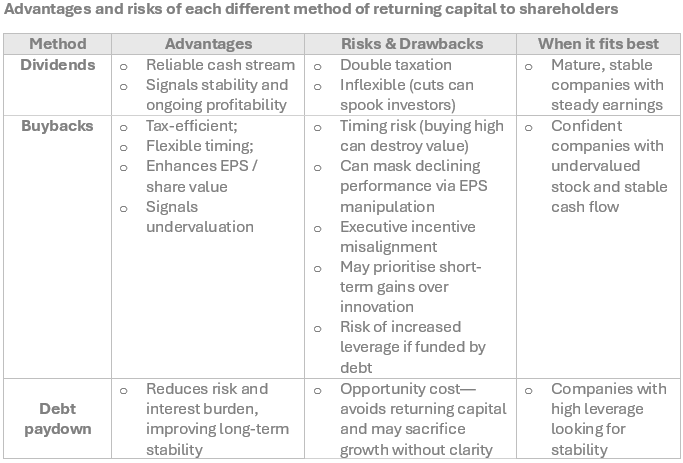
The primary methods to return capital to shareholders are:
- Dividends – cash paid from profits.
- Share buybacks – repurchasing company stock, reducing the share count.
- Debt reduction – using surplus to pay down liabilities, increasing firm value.
Arguments in favour of returning capital to shareholders:
- Efficient use of surplus cash
If a company has excess liquidity and limited investment opportunities, distributing cash via dividends or buybacks ensures capital is not idly trapped—aligned with prudent capital allocation.
- Signal of confidence & undervaluation
Buybacks can signal management believes the stock is undervalued, helping support the share price and investor confidence. Announcements of buybacks often trigger a positive market response. Similarly, consistent dividends signal reliable cash flows and financial stability.
- Enhancing financial metrics & ownership value
Buybacks reduce outstanding shares, thereby boosting earning per share (EPS), and concentrate ownership among the remaining shareholders.
- Improved governance & disciplined management
Consistent return of capital can constrain idle cash accumulation, discourage poor investment decisions, and align management incentives with shareholder interests.
Arguments against returning capital to shareholders:
- Opportunity cost of growth
Allocating funds to payouts may undercut investment in R&D, expansion, or acquisitions, potentially eroding long-term competitiveness.
- Timing risk & potential value destruction
Buybacks initiated at inflated stock prices can harm shareholder value rather than enhance it.
- Metric manipulation
Buybacks can artificially inflate figures like EPS or return on equity (ROE), potentially misleading investors about underlying business performance.
- Executive incentive distortions
When compensation is tied to EPS or stock price, buybacks may be pursued to serve executive interests rather than shareholders’ long-term welfare.
- Debt-financed payout risks
Returning capital via borrowing increases leverage and financial risk, potentially compromising stability.
- Tax burden & inflexibility of dividends
Dividends suffer double taxation (corporate and personal), and once established, cutting dividends can be viewed negatively-risking investor confidence.
- Short-termism & reduced innovation
Over-reliance on buybacks—especially during bull markets—may signal a shift to prioritizing immediate shareholder returns over long-term investment, potentially slowing growth and innovation.
- Agency cost concerns
Excessive payouts can reflect management’s control preferences over shareholder value, and skew decisions that may not benefit minority shareholders.
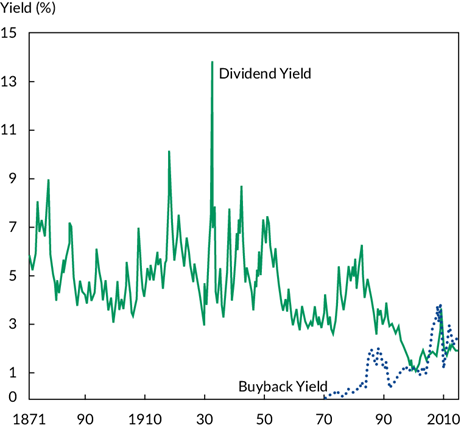
Historically, dividends were the main vehicle for returning cash. Since the 1980s, share buybacks have however surged and often surpass dividends in total outlay.
The graph below illustrates the historical comparison between dividend yield (green) and buyback yield (blue) from 1871 to 2014 (research by Philip U. Straehl and Roger G. Ibbotson, in their study “The Long-Run Drivers of Stock Returns: Total Payouts and the Real Economy.”).
(The data is based on the U.S. stock market, specifically tracking data derived from the S&P 500 and its predecessor indices. These predecessors include earlier benchmarks like the Cowles Commission Index (1871–1925) and the S&P 90 (1926–1957))
The rise from dividend – to shareholder yield
Today, evaluating shareholder yield (dividends + net buybacks + debt reduction) gives a far more complete picture of corporate capital return discipline.
Implications for investors
Just like the fairy tale, empirical data shows that shareholder yield that is not too high nor too low tends to indicate a healthy company from an investor’s point of view.
Evaluating the US S&P 500 over the past 20 years shows that if you exclude the top and bottom 20% of shareholder yield companies, the “goldilocks zone” outperforms the index by 0.9% per annum with lower volatility.
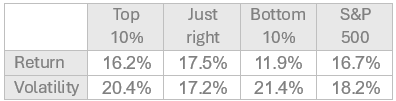
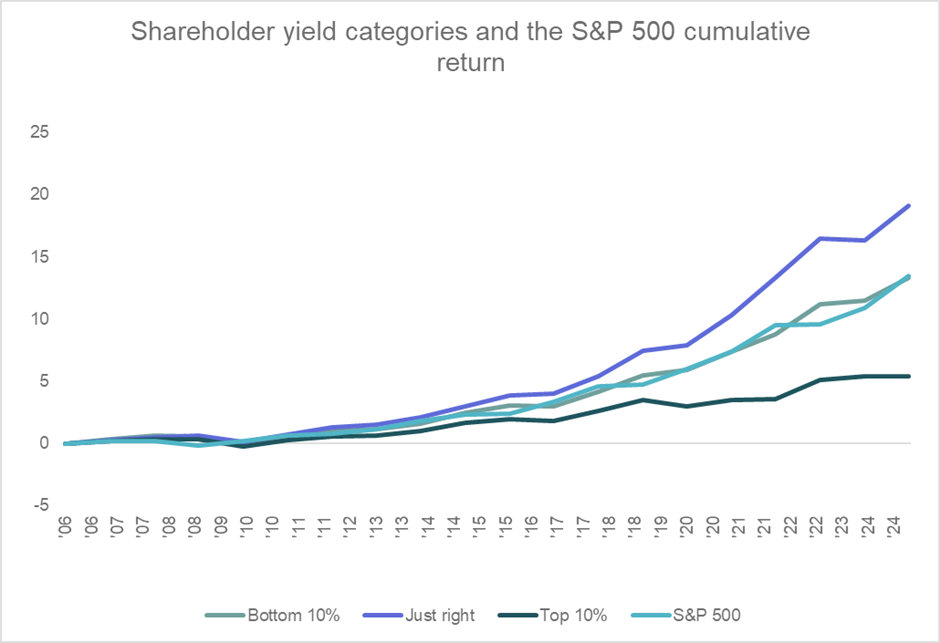
Companies that pay low shareholder yield are either non-profitable companies or companies that believe there are enough growth opportunities to deploy all surplus cash. On the other hand, companies that pay high shareholder yield might have no growth opportunities or may not be prudent enough.
As we have seen, companies can choose to return excess capital to shareholders as part of their capital allocation management.
There are arguments for and against the return of capital to shareholders. Historically, companies preferred to use dividends when returning capital to shareholders, but there has been a shift towards share buybacks as an alternative.
Shareholder yield is a more comprehensive measure of yield as it incorporates dividends, share buybacks and debt reduction. In a world where dividend yields are lower than before, shareholder yield shows that capital is returned via other methods.
We should be cautious of companies with very high or low shareholder yields.
Even though yield is an important aspect of an investment, it should not be the only consideration. At Pyxis we evaluate each of the companies in our portfolio to determine if we are, amongst others, comfortable with their shareholder yield policy.