

A familiar cycle of relief before the long-term trend resumes
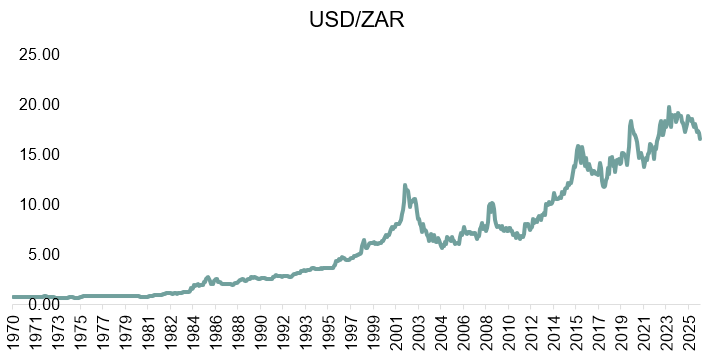
Episodes of Rand strength tend to generate optimism that outstrips their durability. Each time the currency appreciates meaningfully, like the recent break below R16/USD in January 2026, the same question arises: Has something fundamentally changed? History suggests that’s rarely the right question. The more useful one is whether the forces shaping the Rand’s long-term direction have shifted. At present, there’s little evidence that they have.
The Rand’s recent strength has occurred amid no material improvement in South Africa’s growth outlook, fiscal position, or structural competitiveness. Instead, it coincides with US Dollar weakness which is fuelled by fiscal uncertainties, anticipated Fed rate cuts, and global liquidity shifts. In this sense, the move reflects cyclical global forces rather than a change in the currency’s underlying trajectory.
Source: FactSet
A Structural Depreciation Trend
Over more than six decades, the Rand has exhibited a persistent depreciating trend against the US Dollar. This has endured across political regimes, commodity cycles, and monetary frameworks. While the pace has varied, the direction has been remarkably consistent.
The primary drivers are structural: South Africa has run higher inflation than developed markets, delivered lower growth, and required ongoing capital inflows to finance investment and consumption. In such an environment, currency depreciation isn’t an aberration but a mechanism of adjustment which is evident in persistent issues like energy insecurity and fiscal risks.
Strength as Deviation, Not Destination
Importantly, this long-term trend hasn’t precluded periods of significant Rand strength. The currency has repeatedly deviated from its path during favourable global conditions, such as abundant liquidity, strong risk appetite, or supportive commodity prices.
Source: FactSet
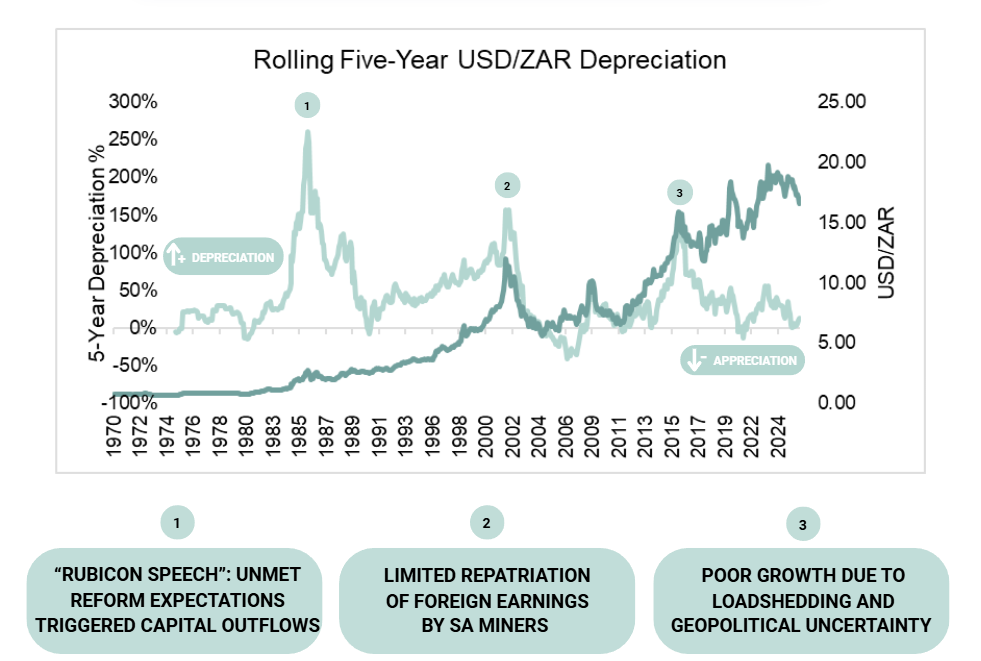
The graph above illustrates how the Rand performed against the US Dollar over every rolling 5-year period since the 1970s.
- Positive % = Rand got weaker (depreciation).
- Negative or low % = Rand got stronger (appreciation).
The mostly high and rising trend shows how the Rand has typically lost 40–80%+ of its value every 5 years. That’s the long-term trend driven by SA’s higher inflation, slower growth, and other structural issues.
The dips and flat spots are the “pauses” during good times (commodity booms, global risk-on periods, or the current rally). Today’s low values (under 20%) highlight recent strength — real relief, but just another temporary break in the upward climb.
Inflation Differentials and Inevitability

Source: FactSet
Over long-term horizons, the Rand’s depreciation closely tracks the cumulative inflation differential between South Africa and the United States. When South African prices rise faster than US prices, the Rand weakens structurally to restore purchasing power parity. This relationship has proven durable despite short-term volatility.
Unless the inflation gap narrows meaningfully and persistently, currency depreciation remains the path of least resistance.
This makes the current episode particularly revealing – while the Rand has strengthened recently, the relative CPI ratio continues to drift higher over the long term, and the underlying drivers of relative inflation and productivity have not improved sufficiently to justify a sustained shift in trend.
Valuation Does Not Negate Structure
Even though the Rand often looks “cheap” compared to the US Dollar, that alone rarely drives a sustainable, lasting rally.
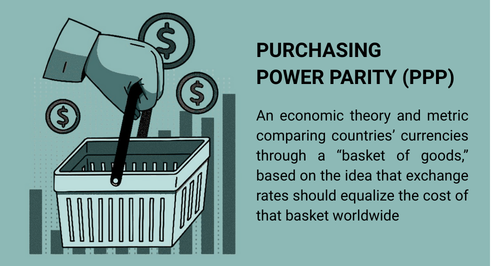
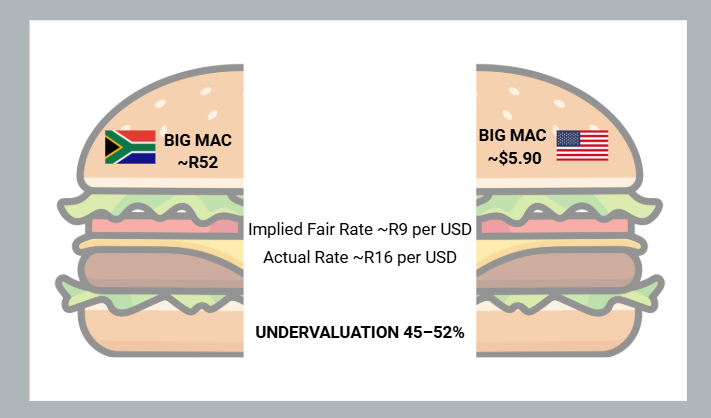
The Big Mac Index compares the price of a McDonald’s Big Mac between two nations to compare purchasing power and provide an indication of what a “fair” exchange rate should be. Right now, a Big Mac in South Africa is roughly R51–R52, while it costs approximately $5.90 in the US. This implies a “fair” exchange rate of around R9 per USD, yet the actual rate is still ~R16. The index implies the Rand remains undervalued by roughly 45–52%.
Rand Undervaluation via Big Mac Index (PPP Proxy)
Source: https://www.economist.com/
While some see this as a reason for optimism, history shows that structural issues like higher relative inflation in South Africa, economic risks, and weak economic growth usually outweigh these valuation gaps. The Rand’s long-term weakness isn’t just a pricing error; it reflects deeper, ongoing constraints.
Big Mac Index Undervaluation of the Rand vs USD
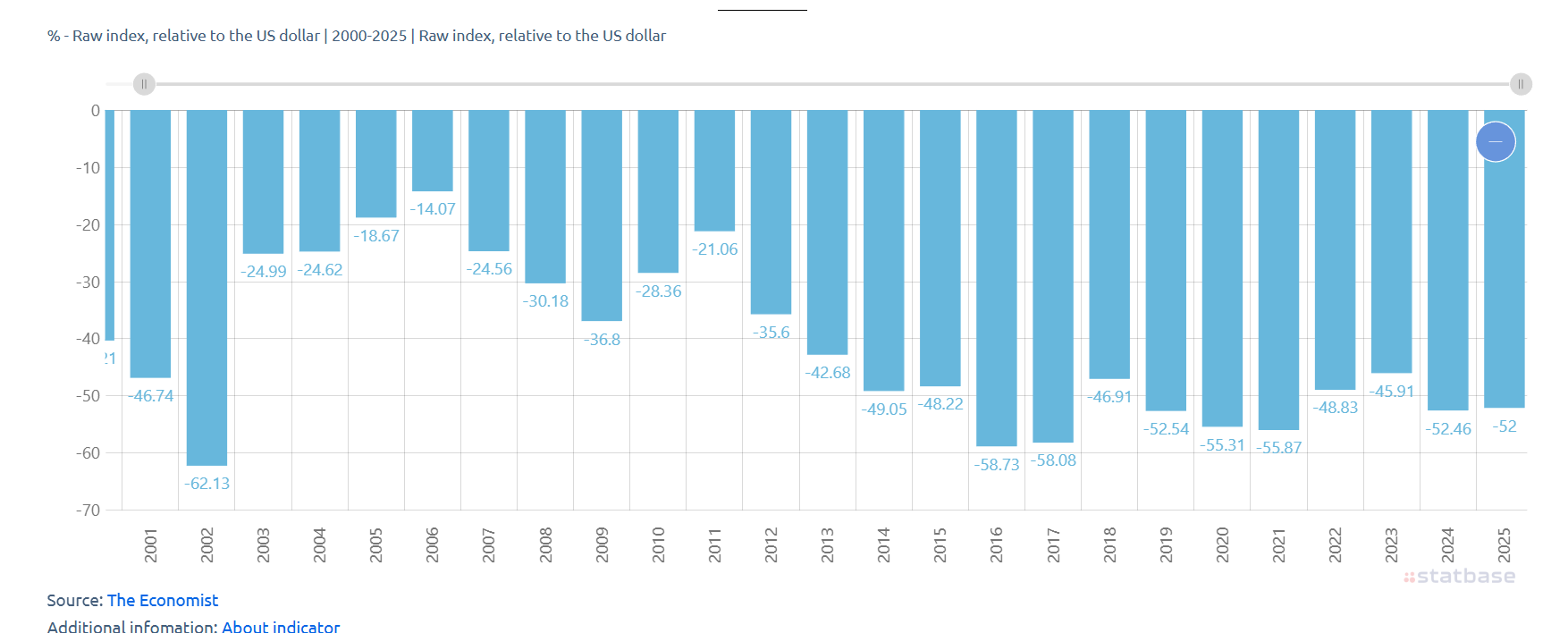
Negative values show the Rand has been undervalued every year. The gap has persisted for over two decades.
Source: https://www.economist.com/ & https://statbase.org/data/zaf-bigmac-index
The Rand’s persistent undervaluation isn’t evidence of imminent appreciation; it’s a reflection of enduring structural constraints.
Why Recent Strength Does Not Change the Outlook
The current appreciation stems primarily from external forces, like a weaker USD amid debasement pressures. Such episodes have occurred many times before and rarely altered the Rand’s direction. When global conditions normalize or tighten, the currency typically resumes depreciating.
From a structural perspective, the question isn’t whether the Rand will weaken again, but when and through which channel.
Implications Across Sectors
Currency trends have uneven effects across the economy and markets. A structurally weakening Rand, punctuated by cyclical strength, carries clear implications:
|
Sector |
Short-Term Impact STRENGTH |
Long-Term Impact Depreciation Trend |
|
Exporters/Resources (e.g., Mining, Industrials) |
Margin squeeze from reduced USD competitiveness |
Benefits from revenue translation; historical entry points during strength |
|
Importers/Retail/Consumers |
Relief via cheaper imports (fuel, goods) |
Reversed gains; higher costs erode margins |
|
Domestically Focused (e.g., Services) |
Limited direct boost |
Exposed to inflationary pressures where pricing power is weak |
|
Investors/Asset Allocation |
Temptation to reduce offshore exposure |
Offshore assets preserve purchasing power, reducing during strength is often costly |
A Trend Worth Respecting
The Rand’s long-term depreciation is not an anomaly to be corrected; it is the logical result of enduring structural differences.
Rallies come and go. They offer welcome breathing room, but they rarely rewrite the direction.
At Pyxis, we acknowledge the long-term fundamentals which have, historically, led to a weaker Rand. Where there is scope to externalise additional funds for clients, periods such as the current one provide attractive opportunity to do so. Portfolios are built to endure short term discrepancies, structured to contain losses in downturns, while benefitting from sustainable growth in times of expansion.